
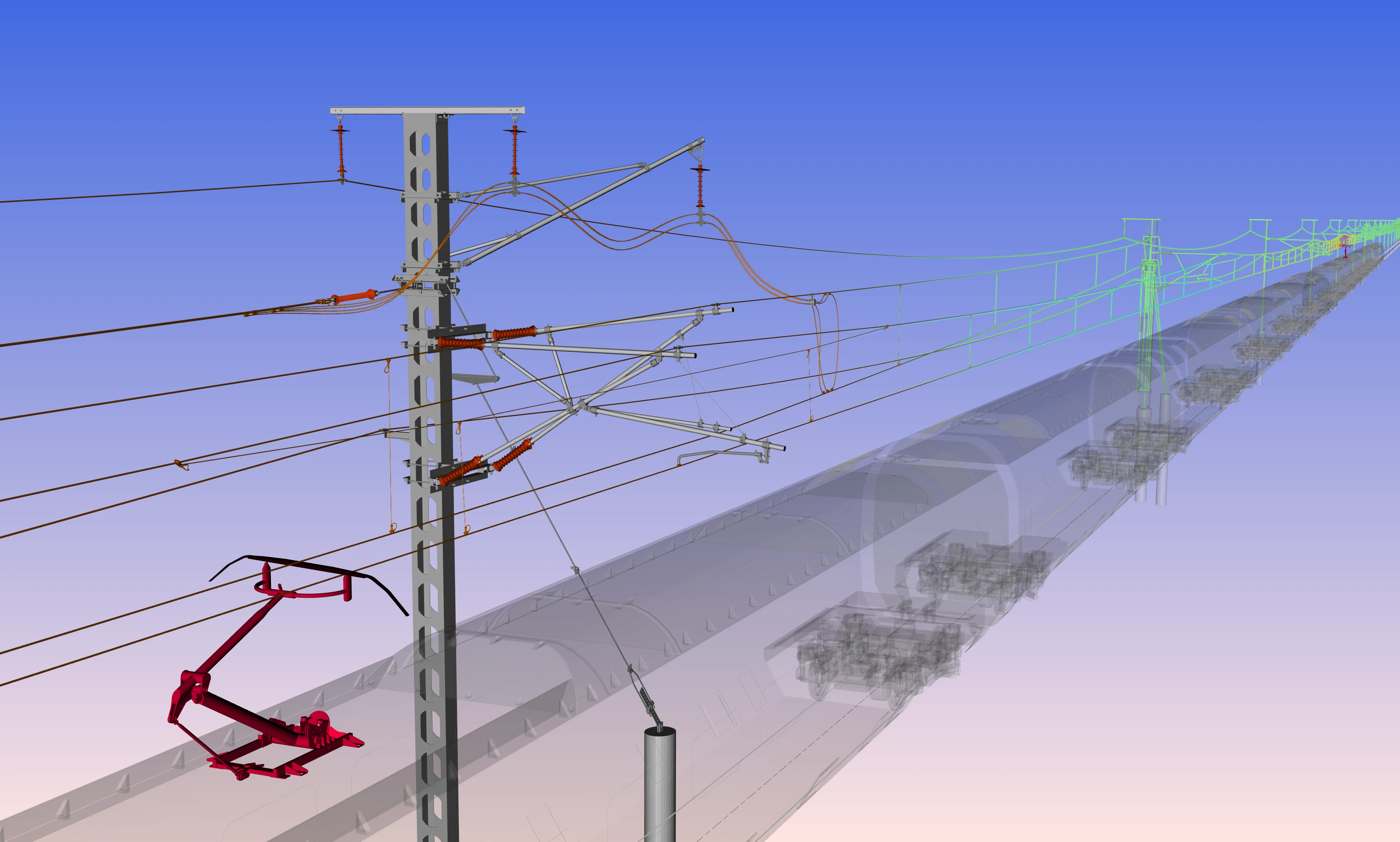
Catenary mathematical model
The catenary mathematical model enables finite-element calculations of static catenary performance and of dynamic interaction between the catenary and electric rolling stock pantographs.
About the project
The model is intended for use in developing technical solutions, designing, and operating the catenary on all electrified sections of the Russian Railways network (including the Moscow – Saint Petersburg high-speed line) and for determining (and refining) the most rational parameters of catenary nodes and structures (such as catenary suspension, anchor-span junctions, average anchoring, air turnouts, supporting and bracing structures, fittings, and so on) while meeting current collection quality requirements at design speeds.
Key points
Catenary model: beam-based, with distributed parameters, built on the finite element method with modelling of catenary suspension, supports, bracing, and other structures, as well as conductors of various purpose in a single static and dynamic system.
Pantograph models: two-, three-, and four-mass with lumped parameters and rigid bodies, based on multibody dynamics, including combined configurations.
Interaction model: based on solving the contact problem using the penalty method.
Verification against EN 50318:2018+A1:2022
Verification on reference models according to EN 50318:2018 was carried out for two model variants: non-sprung and sprung AC catenary suspension. Dynamic pantograph interaction modelling was performed at speeds of 275 and 320 km/h.
Verification by comparison with field test results cited in EN 50318:2018 was performed for two variants: non-sprung and sprung AC catenary suspension. The catenary suspension models comprised three anchor spans, and the analysis sections were over one kilometre long with 22 spans per model.
Train run on the test ring
Footage of an actual run showing how the pantograph interacts with the catenary during model validation.
Validation of the static KS-400 catenary mathematical model at the VNIIZHT experimental ring
Validation of the static KS-400 catenary mathematical model based on operational trials of the KS-400 catenary product range at the VNIIZHT experimental ring was performed by comparing calculated catenary suspension elasticity with field test data. Elasticity values were compared under each dropper and in inter-dropper spans of the analysed suspension sections. The maximum elasticity difference at all control points was 9.5%; the mean deviation was 3%.